May-2024
International Data Corporation (IDC) is the premier global provider of market intelligence, advisory services, and events for the information technology, telecommunications, and consumer technology markets.
Our customers trust us to answer how Technology is impacting businesses and customers. As one of the world’s most trusted providers of technology data and market insights, we empower business and IT leaders to make confident technology decisions and gain a competitive advantage on critical business outcomes.
Actionable Data and Insights
Explore technology markets, track real-time data on consumer technology products, and get the latest analysis and insights on technology agendas critical to your business. Explore our Solutions →
Strategic Consulting
Make confident decisions at the right time with IDC’s executive programs and custom solutions, and access over 1,300 expert analysts to help you navigate the complex technology business landscape. Meet our Analysts →
Event and Go-to-Market Solutions
Experience IDC’s live and on-demand events and engage with business and tech leaders, IDC Analysts, and industry experts. IDC offers full-service event execution. Become our Partner →
We know Technology.
Learn how IDC can help your business today →
Global View. Local Expertise
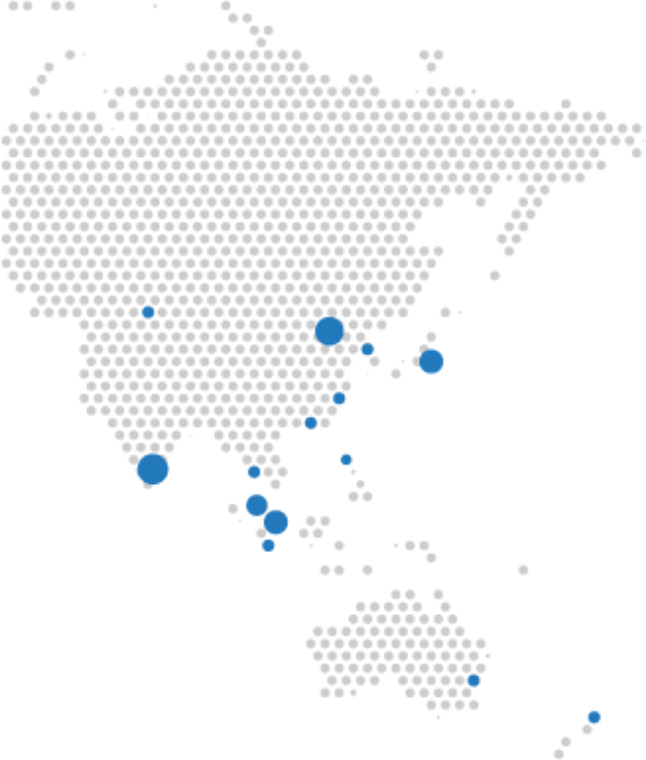
Asia/Pacific Coverage:
Australia, China, Hong Kong, India, Japan, New Zealand, Philippines, Singapore, South Korea, Taiwan, Thailand, Vietnam
400+ Analysts
14 Countries
700+ Employees
20.000 Clients
Explore local AP pages:
Understand the Players in Your Tech Markets
Analyze company profiles, tech spending and supplier ecosystems.
Built from IDC´s analyst-led, proprietary datasets, Company Lens gives you the intelligence you need to assets competitors, find new routes to market, and gain market share.
Explore Company LensLatest Research Published by IDC Analysts
Latest Industry News and Press Releases
-
IDC:2024 年第一季全球平板電腦出貨出現復甦跡象Learn More
May-2024
-
产业互联与数字化改造走向融合,IDC发布中国产业链协同平台报告Learn More
May-2024
-
IDC发布2023-2028年中国电力行业ICT市场预测Learn More
May-2024
-
IDC:汽车行业进入智能化“内卷”,汽车云市场增速维持高位Learn More
May-2024
-
融合、升级、AI,IDC金融领域数据管理分析市场最佳实践案例发布Learn More
May-2024
- Learn More
- Learn More
- Learn More
- Learn More
-
IDC:2023 年全球智慧吸塵器市場出貨量達1,850 萬台Learn More
Apr-2024
Latest IDC in the News
IDC Video Broadcast
Submit Your Digital Initiatives Before
14 June 2024.
View start-up special
Key Interest Areas
- Subscription Services
- IDC Trackers
- IDC Industry Insights Research
- IT Executive Program
- 3rd Platform Research
- IDC DecisionScapes
- Digital Transformation
- Sourcing Advisory Services
Analyst Spotlight


The era of digital transformation is evolving into the digital business era... Leading enterprises are now primed to build and scale new business models to run a viable sustainable digital business for the long term.
Read moreSandra Ng
Group Vice President and General Manager
Primary Research Service Selected:
Secondary Tech Content Selected:
IT Market Overview and Perspectives
- Asia/Pacific Agile Software and Sourcing Strategies
- Asia/Pacific Augmented and Virtual Reality
- Asia/Pacific Blockchain Strategies
- Asia/Pacific Agile Software and Sourcing Strategies
- Asia/Pacific Datacenter Markets: Infrastructure and IT Services
- Asia/Pacific Digital Commerce
- Asia/Pacific Digital Transformation Strategies
- Asia/Pacific Future of Commerce
IT Services
- Asia/Pacific Communications Service Provider Business Transformation Strategies
- Asia/Pacific Communications Service Provider Technology Strategies
- Asia/Pacific Managed Security Services: Benchmark Analysis for Commonly Used Service-Level Agreement (SLA) Metrics 2017
- Asia/Pacific Next-Gen Infrastructure Services
- Asia/Pacific Next-Generation Imaging, Printing and Document Solutions
- Asia/Pacific Services Opportunities

Primary Research Service Selected:
Secondary Tech Content Selected:
IT Services
- Asia/Pacific Communications Service Provider Business Transformation Strategies
- Asia/Pacific Communications Service Provider Technology Strategies
- Asia/Pacific Managed Security Services: Benchmark Analysis for Commonly Used Service-Level Agreement (SLA) Metrics 2017
- Asia/Pacific Next-Gen Infrastructure Services
- Asia/Pacific Next-Generation Imaging, Printing and Document Solutions
- Asia/Pacific Services Opportunities
Add-on Event Sponsorship:
IDC CIO Summit Singapore 2019
- Coming soon

Primary Research Service Selected:
Geo Content Selected:
CHINA
- China Cloud Market
- China Cloud Market (Chinese Version)
- China Cloud Services
- China Internet of Things Ecosystem and Trends
- China Datacenter Market (Chinese Version)
- China Enterprise Mobility
- China IT Opportunity
- China IT Opportunity (Chinese Version)
- China Blockchain Strategies
- China Blockchain Strategies (Chinese Version)
- China Gaming Market
- China Gaming Market (Chinese Version)
- China Internet Industry Strategies
- China Smart Home (Chinese Version) 2018
- IDC Government Insights: China Government and Smart Cities Digital Transformation Strategies
- IDC Health Insights: China Healthcare Digital Transformation Strategies
- China Artificial Intelligence and Big Data Strategies
- China IT Security Solutions
- China IT Security Solutions (Chinese Version)
- China IT Services

Internet of Things

Big Data
Financial Insights
- IDC Financial Insights: Asia/Pacific Financial Services IT Strategies
- IDC Financial Insights: Canadian Financial Industry Strategies
- IDC Financial Insights: Consumer Banking Engagement Strategies
- IDC Financial Insights: European Banking Digital Transformation Strategies
- IDC Financial Insights: Middle East and Africa Banking IT Strategies
- IDC Financial Insights: Worldwide Banking Digital Transformation Strategies
- IDC Financial Insights: Worldwide Compliance, Fraud and Risk Analytics Strategies
- IDC Financial Insights: Worldwide Corporate Banking Digital Transformation Strategies
- IDC Financial Insights: Worldwide Insurance Digital Transformation Strategies
- IDC Financial Insights: Worldwide Payment Strategies